
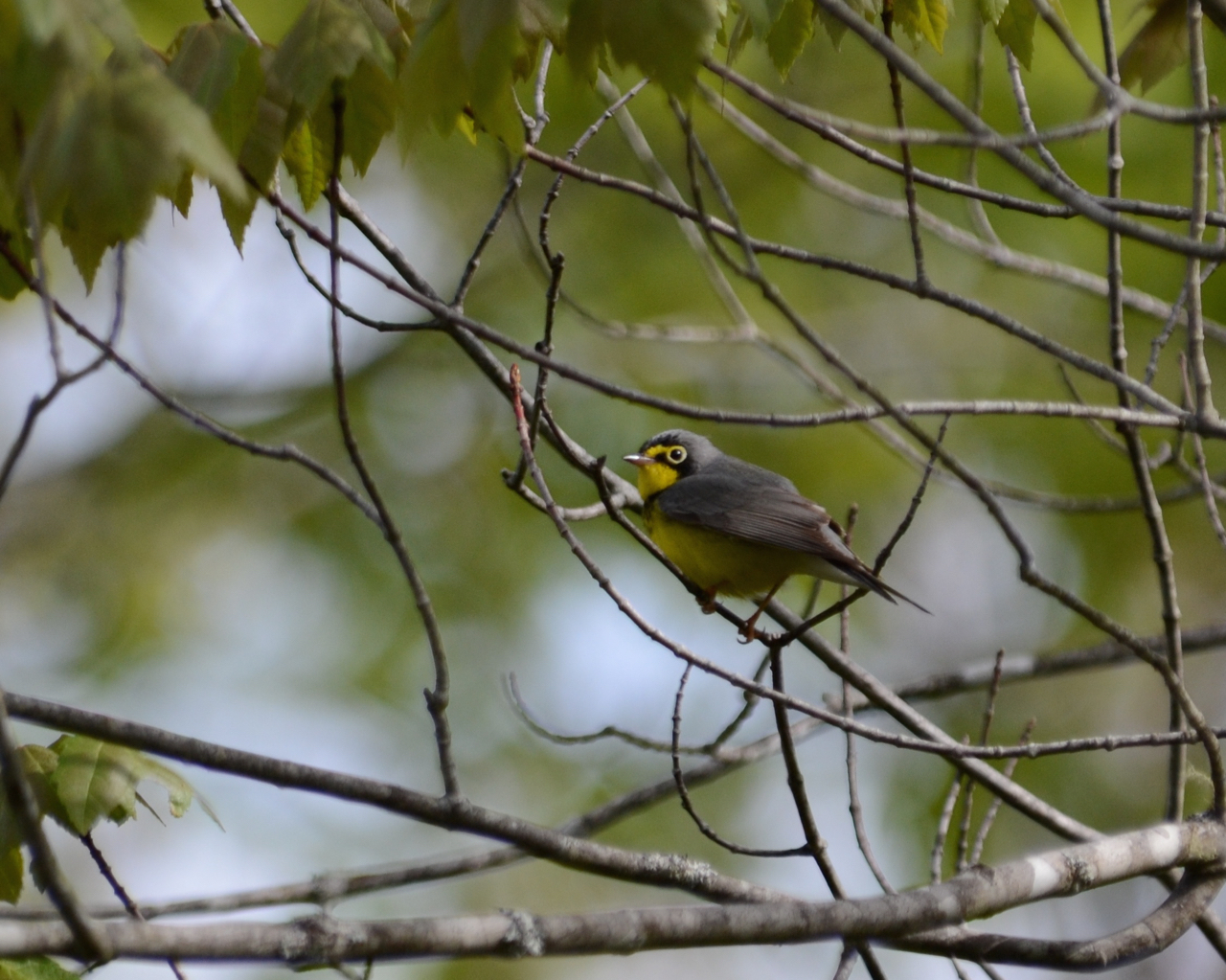
The Canada Warbler is one of the latest arriving of the 26 warbler species that split their lives between Maine and the tropics of Central and South America and the Caribbean. Only some are lucky enough to see a Canada Warbler, usually after hearing the male first: a chip and then a snappy, exuberant warble, described memorably in Roger Tory Peterson’s classic Field Guide to the Birds as “chup, chupity, sweet ditchety.”
The male sings from a perch on a mossy branch low in the bushes, in a forest of mixed evergreens and hardwoods, a stream trickling nearby. He is a small warbler, bright yellow below and blue-gray above, except for splotches of black that form a necklace across his yellow breast (“as round and black-flaming as a rising sun,” wrote poet Galway Kinnell). Black trim framing the yellow throat quickly fades to gray along the head and back. His large, black eyes are encircled in a thin ring of yellowish-white.
Between songs, the male is prone to hop from branch to branch, snacking on spiders and hawking insects from the air. He is here in Maine for the breeding season and helps tend his young in a nest hidden beneath a loosened root, or in a hollow of moss amid crowded plant stems, or the folds of a moldering stump.
Read more at Natural Resources Council of Maine.
 Catherine Schmitt